

Design With Light: Honoring a Legacy That Continues to Shape How We Engineer Shade
April 7, 2026
Some buildings are designed around structure, while others are designed around light. The work of Frank Gehry challenged that distinction. His architecture made light visible and intentional. It became part of the form, rather than something that simply filled the space.
With his passing late last year, there is an opportunity to reflect not only on what was built, but on what was required to support it. His work did more than shape skylines. It raised expectations for how buildings perform, particularly in how they manage and respond to light.
From the sculptural titanium of the Guggenheim Museum Bilbao to the luminous volumes of the Walt Disney Concert Hall, his work reinforced a simple but important idea. Light is not a finishing detail - it is a design element that must be considered from the start.
When Architecture Designs with Light
Expansive glazing and expressive geometry create powerful architectural experiences, but they also introduce real performance demands. Glare, solar heat gain, energy use, and occupant experience become central to how a space functions.
In buildings where glass defines the experience, shading absolutely cannot be treated as an afterthought. It must be integrated into the architectural solution from the beginning.
At Mecho, architecture that designs with light has consistently influenced how we approach innovation. These projects require tighter tolerances, cleaner integration, and systems that perform across varied exposures and unconventional forms. They have driven our work in solar optical fabrics, refined hardware, and real-time intelligent control capabilities that act on changing daylight conditions.
Engineering in Response to Complexity
Architecture that pushes boundaries requires more than a single solution. It requires systems that can perform under different conditions while maintaining consistency and precision. These include high-performance manual systems such as Mecho/7, engineered to support larger spans, coupled shades, and precise alignment across complex façades. They also include motorized and automated systems that respond dynamically to daylight conditions in addition to specialty and custom shade solutions designed to integrate with unique geometries and architectural details.
Each application presents its own constraints, but the expectation remains consistent: window covering systems must deliver precision, reliability, and alignment with both the design intent and the facility’s function.
As our VP of Engineering noted:
Project Experience in Complex Architecture
The influence of architecture that designs with light is reflected in the projects we have been trusted to support. Frank Gehry was certainly at the forefront of challenging architectural norms and by doing so challenged Mecho to advance its own capabilities. The following are just a few of many examples across cultural, institutional, and workplace environments where performance and design are closely connected and where Mecho was able to contribute to the end-product.
Walt Disney Concert Hall
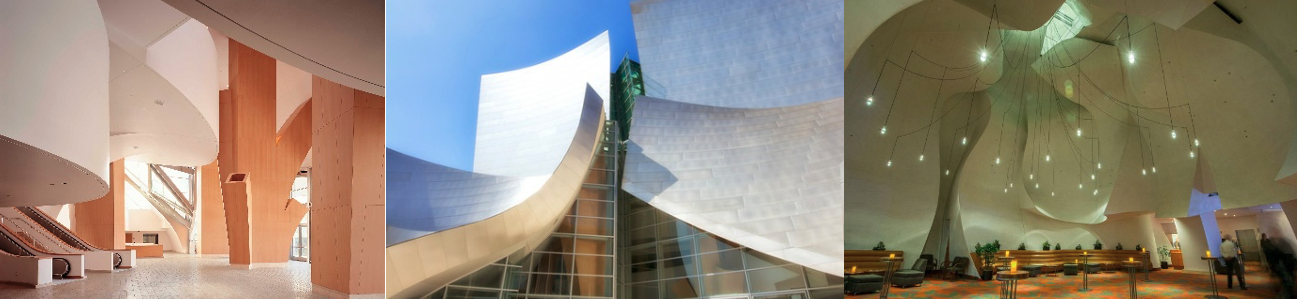
A highly visible and architecturally expressive space where daylight, form, and materiality intersect. Shading systems were required to manage light while maintaining the integrity of the interior experience.